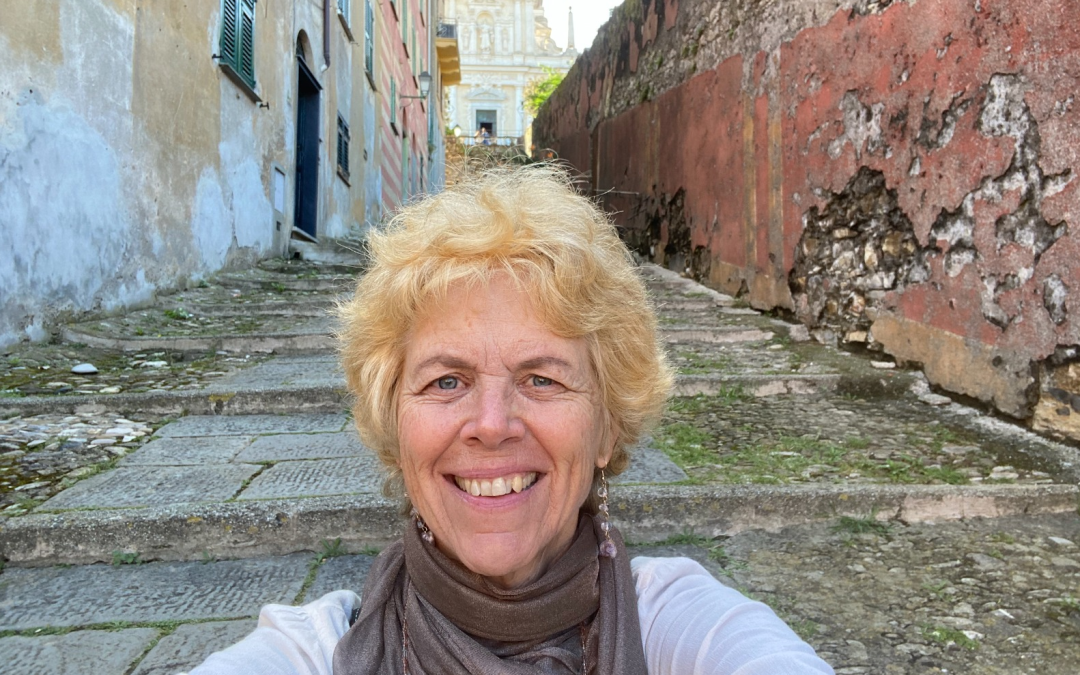
“Cancellato.”
Thus read the screen next to my 5pm train listing.
I was heading back to Santa Marguerita Ligure, where my luggage and comfy bed awaited about an hour away. Despite my lack of Italian, “Cancellato” wasn’t hard to translate.
“Canceled.”
My body froze as I struggled to make sense of the situation. My stomach dropped as I realized I had made a big mistake in taking the train to Levanto earlier that afternoon.
When I had arrived that morning to buy my ticket, the windows were closed, with a paper sign that read, “Scopero,” (“Strike”).
Yet trains had been running all morning, and riders were coming and going calmly. The automated ticket machines were working fine.
“Well,” I thought to myself. “Everything seems to be running smoothly.”
And so, I bought the ticket.
Looking back now several hours later, I wondered. “Surely they wouldn’t sell me a round trip ticket if they knew I couldn’t get back?”
“Surely they won’t let a foreigner, who doesn’t speak Italian, and has been in the country for less than 48 hours, get on the train south with no car, no taxi number, no family or friends in the country, a barely working phone, and no way to get back to my little home base with my suitcases and rented sheets and towels for the night?”
“They wouldn’t do that… would they?”
But clearly, they had.
Every train heading home that afternoon displayed the same word: “Cancellato.” Apparently no train had run that way for 6 hours.
I looked around the station and took stock. About 50 people were milling about, wondering what to do.
Several of us went outside, searching for a taxi stand. A sign read “Taxi,” but there were no cars, and no phone number.
We started talking, sharing stories and strategies. How had we each gotten stuck here? Would the next train come or not? Would we be able to return “home?”
After about 15 minutes, one lone taxi showed up, immediately surrounded by 20 tourists. But the driver refused to take any of us, saying he had another appointment.
I met two young women from Australia and a group of European tourists. We agreed that if any of us were lucky enough to secure a taxi we would share the ride.
A future train appeared on the screen, set to depart an hour later. We stood in a long line as the agent rebooked us for the next train, saying in English that we should “pray” the train would come.
But the hour came and went without a train. Ten minutes after its expected arrival, the now familiar word appeared again on the screen, “Cancellato.”
We continued waiting outside the station, hoping the lone taxi would return, and wondering how many of us might fit inside.
We were never to see the taxi again.
* * * * * * * * *
“Be careful in Italian train stations,” the YouTube video had warned. Before my trip, I watched videos of beautiful cities to visit, learned simple Italian phrases, and familiarized myself with local customs.
But YouTube also highlighted scams to avoid. Apparently Italian train stations are notorious for pickpockets and thieves who work together to target tourists or pose as fellow tourists in need.
YouTube warnings aside, making friends is a survival skill in times of trouble, so I set about being friendly and personable.
None of the tourists I befriended had phone numbers for a taxi. Uber is banned in Italy, as the unions are strong. I messaged my host on Booking.com for a taxi number, but was given a wrong number, then another that was the lone driver I had seen earlier. No help there.
I soon made friends with two young Italians, a graphic designer and an architect, both needing to get back to Rome the next day for work. Despite missing the memo about the strike, they understood the signage and how to navigate the station better than I, so I decided to stick close to them.
One of my new friends called his parents in the next town and convinced them to come for dinner and pick him and his friend up at the station. They didn’t offer to take me with them.
My friend said that if I still didn’t have a ride after their dinner, he could take me to his parents’ house, which was part-way in the direction I needed to go.
Even though we exchanged phone numbers, I wasn’t convinced I would see him or his parents again. Dinners in Italy can last hours and it was already 8pm. Would they really come back for me? I wasn’t so sure.
Once again, I found myself alone.
* * * * * * * * * * * *
As I sat in the Italian train station, I thought back on other travel adventures gone wrong.
The first time I went to Mexico, I was barely 25 and spoke almost no Spanish. I was studying at a language immersion program in Cuernavaca and we took a day excursion to Mexico City, an hour away.
I was on my period, with strong menstrual cramps that made it hard to keep up with the group. I left them to find a pharmacy and buy some ibuprofen. Little did I realize that on Sundays, most Mexican pharmacies are closed. I wandered long blocks alone, in pain, seeking an open pharmacy.
I took refuge at a market where I had a halting conversation with an indigenous woman from Oaxaca, who was selling woven rugs, bags, and blankets. Her lack of Spanish (Oaxacan being her first language) and mine were a match. Somehow we managed to make friends, and she let me sit in the back of her stall with her child, where I got some needed rest.
Even though I was probably quite safe that day, I felt all alone in a vast city, unable to communicate, and struggling with cramps. I don’t remember how I finally met back up with my group, but later that day I did find a pharmacy and make it back to Cuernavaca. The memory of being all alone in Mexico City, wandering empty streets on a Sunday, has always stuck with me.
In India, I was befriended by a wealthy businessman, a patron of Buddhism and a donor for a University Yoga Philosophy program in the United States. During my first trip to India, he courted me for a position coordinating the program and offered to take me on an all-expenses-paid trip to Varanasi, where Asian Buddhist monks were holding a conference with a filmmaker.
Unsure about accepting such a generous offer, I asked my mentor and tourguide, a professor from the American University, if it was a good idea. He assured me everything was legitimate and encouraged me to go.
A few days later, we arrived in Varanasi only to find out that there were “no extra rooms” at the hotel, and I would need to share a room with my much older, married, Indian host.
Alarm bells went off in my mind, but the only other option was staying at a different hotel, who knew where or how far away. With no one around who spoke English, no knowledge of Hindi, and no idea of how to get food or transportation, I felt completely vulnerable. I opted to share the room.
Over the weekend, he made a pass at me, first grabbing my rear as I got out of the car and later suggesting we “exchange massages” at bedtime, claiming that his family did this every night. Even though he pretended to be surprised when I refused, he nonetheless backed off.
While I knew he was unlikely to become violent, I was terrified by how close I had come to a dangerous situation. Men everywhere can hope to get lucky with a young foreigner. I said no and pulled myself into my own small double bed, praying for safety.
Despite this close call, I don’t regret going to Varanasi. I attended a Buddhist conference where I was the only woman present and had the opportunity to meet the Dalai Lama. In a circle of about 50 people sitting at conference tables, translators gave translations through headsets.
I sat directly across from the Dalai Lama, wearing the pink dress I had bought on my first day in New Delhi. He commented to the monks that they should emulate my posture, noting how straight I sat as I listened.
I enjoyed a rowboat ride on the Ganges, seeing women washing clothes, goats wandering, and movies being filmed on the narrow banks and steps that led to the massive river. The river reminded me of the Mississippi, where I grew up, but the Ganges enjoyed much more reverence and attention. Fascinating.
Two days later I met the businessman’s wife, children and grandchildren as we returned to New Delhi. I wondered if his family had any idea he had had me share his hotel room because the hotel was “sold out.” I was relieved to be leaving on a bus for Jaipur that afternoon.
As difficult as unplanned adventures may be, I appreciate the way they take me deeper into the heart of a country.
No tour guide or YouTube video could have taught me about Italy the way this train strike did.
Up until this point everyone in Italy had been enthusiastic to offer support, bending over backwards even. But now, I saw taxi drivers refusing eye contact and driving off with an empty car despite desperate crowds, “friends” who went off to dinner with their parents without me, and Italian ticket machines that sold a round trip ticket without actually committing to get me back home safely.
Could I stay relaxed in my heart and being, even seeing the negative as well as the positive sides of Italy?
* * * * * * * * * * * *
Sometimes I forget what it’s like to be single, or to be a solo traveler. As I continued to wait in the station, I reflected on what it felt like to be in Italy for the first time, traveling without my husband.
In a way, I enjoyed the challenge of being alone during this train strike. I’m an unconventional traveler, and this Italian trip was no different. Most of the people I saw were traveling in groups or pairs. At the train station I met no one else traveling solo.
I had come to Italy early to allow three days to adjust to the time zone before attending a business seminar in Lake Como. After the seminar, I was to meet up with my husband to see Florence and Assisi.
But for now I was alone, having my own adventure, free to come and go as I chose, free to get lost in the twisting alleys of Santa Marguerita Ligure, free to lose my one set of condo keys, or to get stranded in the midst of a train strike. And this, I most certainly did.
Decades of Yoga practice have taught me to meet any challenge with breath and pure awareness. So, I simply sat and breathed, resting into the aloneness I was experiencing. Nothing to do, nowhere to go. Just being and presence.
I sat at the curb in front of the station, quiet and relaxed, but kept my eyes open, watching for arriving cars or any information that might provide a way to get home.
I was pretty sure I would get back to my waiting luggage and bed. But as the hours dragged on, I became less and less certain.
My stomach began to growl and the extra clothes I had put on seemed to have worn thin. I felt the air cool on my skin as the sun set. The idea of sleeping on that hard train floor became more uncomfortable. The stories I had heard on YouTube of Italian pickpockets or thieves posing as tourists flooded my mind, and I tried to push them out and focus on the moment.
Nothing to do, nowhere to go.
I sat and waited.
And waited.
And waited.
* * * * * * * * * * * *
I finally stumbled into a small restaurant near my home at 10:30pm that night. Yes, it was still open and serving dinner. “Zuppa?” (Soup?) I asked. “No, non c’e hai.” “No, there isn’t any.” I chose gluten free pasta with seafood instead, carrying the takeout up the small hill to my apartment.
An hour earlier, I had at long last gotten into a taxi by begging 4 tourists whose AirBnB had sent a rescue vehicle. “Please, I’m 60 ~ I can’t sleep on the floor. Please, my husband is worried about me.” Tears began to fall as I said those words.
Fortunately the tourists took pity on me. From among the crowds of younger travelers, they told the driver to let me in the vehicle. It was a minor miracle. Being reasonable hadn’t worked, and that cement floor was looking less and less desirable as my sleeping spot for the night.
Unlike the train station during the strike, the restaurant near my home was filled with Italians and almost no tourists. Tears of letdown and relief rolled down my cheeks as I sat waiting for my order.
I was aware of being the only solo diner in the restaurant, but I felt safer now, knowing I was only two blocks away from the bed I had slept on for two nights already. It’s funny how a place can feel like home so quickly.
I didn’t care if the other diners saw me ragged, heard my poor Italian, or saw the tears on my cheeks. They looked at me calmly, and then went back to their conversations and dinner. I wasn’t unique or a big surprise to them.
Apparently train strikes are a way of life here.
* * * * * * * * * * * *
Do I regret getting stuck in a train strike, lost in Mexico city, or getting into a close call in India? No, I don’t. I’m grateful for the way I live ~ venturing beyond my comfort zone to explore this planet and the wide range of humanity.
Without these experiences, I wouldn’t have met that Oaxacan craftswoman three decades ago, the Dalai Lama two decades ago, or countless other travelers facing a common challenge in the strike.
For me, choosing to go to a country, alone, even when I don’t speak the language, is an exercise that forces me out of my regular routine.
I love this Laura style travel, where I intentionally venture away from the Club Med version that provides pre-packaged and sanitized English translations.
Like entering a challenging yoga pose where there’s nothing to do but just breathe and feel, I step off the beaten path, leaving behind all that is familiar. I experience my essential human-ness and I feel that in those around me.
As the Buddha said, every person’s blood runs red and all our tears are salty. He was referring to our shared humanity across skin color, but the same truth holds across language and nationality.
When language and culture are stripped away, we have no choice but to embrace beginner’s mind. In this state of innocence we feel the commonalities of life ~ breath, friendship, care, our needs for sleep, shelter, safety, and yes, freedom from unwanted sexual advances.
The breadth of my experiences prepares me to understand and empathize with the stories my clients live, the narratives they write, and the journeys of their own clients.
Now I’d love to hear about your adventures. How do you venture off the beaten path? What is your means to explore our shared humanity?
I eagerly await your comments below.
With blessings and heartfelt gratitude,
Laura Joan Cornell, PhD
Best-Selling Author, Sacred Writing and Sacred Business Mentor
Recent Comments